

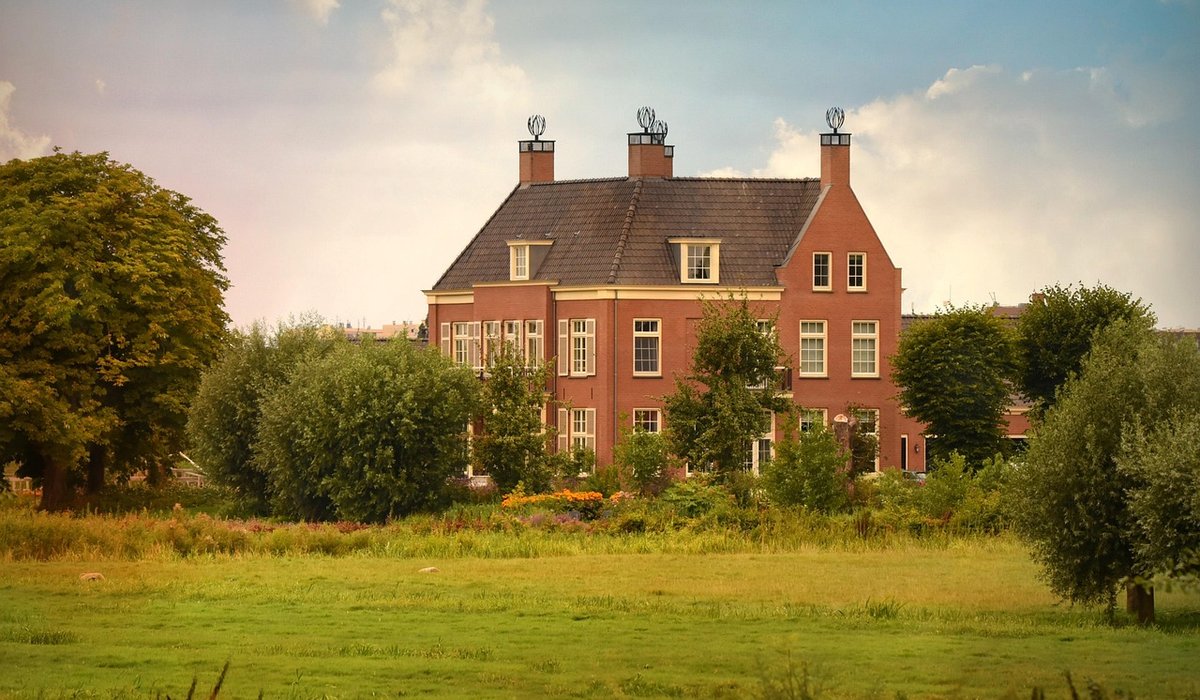
Standing in the courtyard of a country house, most of us can sense that we are looking at something old — but knowing precisely how old, and why, is where the pleasure really begins. Architecture is a language, and like any language it rewards a little vocabulary. This guide will give you enough to walk up a drive, glance at a façade, and start reading its story.
Start With the Shape of the Building
Before you examine a single window, step back and look at the overall plan. The silhouette tells you more than any detail.
A medieval hall house is rarely symmetrical. It grew organically, often around a great hall open to the roof, with wings tacked on as families and fortunes demanded. Expect irregular rooflines, chimneys added wherever a hearth was needed, and a general air of having been assembled rather than designed.
The Tudor and Elizabethan house is taller and more confident, frequently built around a courtyard and often shaped like an E or an H on plan — the E sometimes said to flatter Elizabeth I, though practicality (a central entrance with projecting wings) probably had more to do with it.
The Georgian house is the easy one to spot. It is a neat, balanced rectangle with a symmetrical front, a shallow-pitched roof often hidden behind a parapet, and a front door placed dead centre. If you could fold the façade in half and have the two sides match, you are almost certainly looking at the eighteenth century.
Windows: The Quickest Clue of All
If you learn only one thing, learn windows. They date a building faster than any other feature.
- Mullioned windows — stone vertical bars (mullions) dividing the opening into two or more lights. Classic Tudor and Jacobean, and often paired with a transom, a horizontal bar across the middle.
- Leaded lights — small diamond or rectangular panes held in lead cames. Medieval and Tudor through to the seventeenth century, and much revived by the Victorians for romantic effect.
- Sash windows — two sliding frames, one moving up and down behind the other. This is the Georgian signature, and the more panes per sash (six over six, say), the earlier the window usually is. By the later Georgian and Regency periods, sashes grew thinner and sometimes had only a single pane each.
- Bay and bow windows — projecting outward, popular from the Georgian period onwards and much loved by the Victorians.
A house with mullions at the back and sashes at the front is telling you it was modernised, not rebuilt. Look for the ghost of an old window — a patch of different brick or stone — where an earlier opening once sat.
Brick, Stone and the Story They Tell
Materials are local, and local materials date a building too. Timber-framed houses with close-studded oak and plaster infill belong largely to the fifteenth and sixteenth centuries; the more elaborate the framing, the later it tends to be. Red brick arrived in earnest in the Tudor period, often laid in diaper patterns — diamonds of contrasting brick — or with diaper and English bond coursing that you can count like rings on a tree.
Stone houses vary enormously by region: limestone in the Cotswolds and Derbyshire, sandstone in the Welsh borders, flint and brick in East Anglia. Georgian builders favoured brick with stone dressings — stone quoins at the corners, stone keystones above windows — precisely because it looked tidy and expensive.
Rooflines, Chimneys and Doors
Look up. A steeply pitched roof with tall, ornate brick chimney stacks suggests the Tudor and Jacobean love of display. Georgian roofs are shallow and often concealed, with chimney stacks arranged symmetrically along the ridge — a row of them, evenly spaced, doing their quiet geometric duty.
The front door is another giveaway. A Tudor doorway is often four-centred, with a hood mould above it. A Georgian door is framed by a fanlight, a slender semi-circular window above, sometimes with a delicate wrought-iron fan or radial glazing bars, and flanked by columns or pilasters. A Roman Doric porch with a triangular pediment is about as Georgian as it gets.
Reading Alterations Like a Detective
Almost no historic house is a single moment in time, and that is the joy of it. Train your eye for the joins.
- Change of brick colour or bond in the middle of a wall usually marks a later extension or a rebuilt section.
- Windows that do not line up vertically between floors point to an internal replanning — a Georgian remodelling of an older core, perhaps.
- A façade that looks Georgian but a plan that does not (odd chimney positions, a hall off-centre) suggests an older house given a fashionable new face.
- Rooflines that step down between sections reveal the sequence of building.
- Blocked doorways and filled-in windows, often visible as faint outlines in the render, tell of rooms that were once external or public and became private.
Take binoculars if you can, and a notebook. National Trust and Historic Houses properties usually publish a short architectural guide, and a few minutes with it before you wander will transform what you see.
Putting It All Together
Here is a quick method for your next visit. Stand back and decide the plan: irregular or symmetrical. Then check the windows: mullions, leaded lights or sashes. Then the materials and the roofline. Then hunt for the joins. In five minutes, you will have a rough century, a likely building sequence, and a much richer sense of the people who kept adding to the place.
Reading a manor house is not about passing an exam. It is about slowing down enough to notice that a wall, a window or a chimney is a sentence someone wrote four hundred years ago — and that you can still understand it.


Coding is used in almost all aspects of life and work now, be it directly or indirectly. It’s not just for companies in the tech sector. “An increasing number of businesses rely on computer code,
Coding is used in almost all aspects of life and work now, be it directly or indirectly. It’s not just for companies in the tech sector. “An increasing number of businesses rely on computer code,
Coding is used in almost all aspects of life and work now, be it directly or indirectly. It’s not just for companies in the tech sector. “An increasing number of businesses rely on computer code,